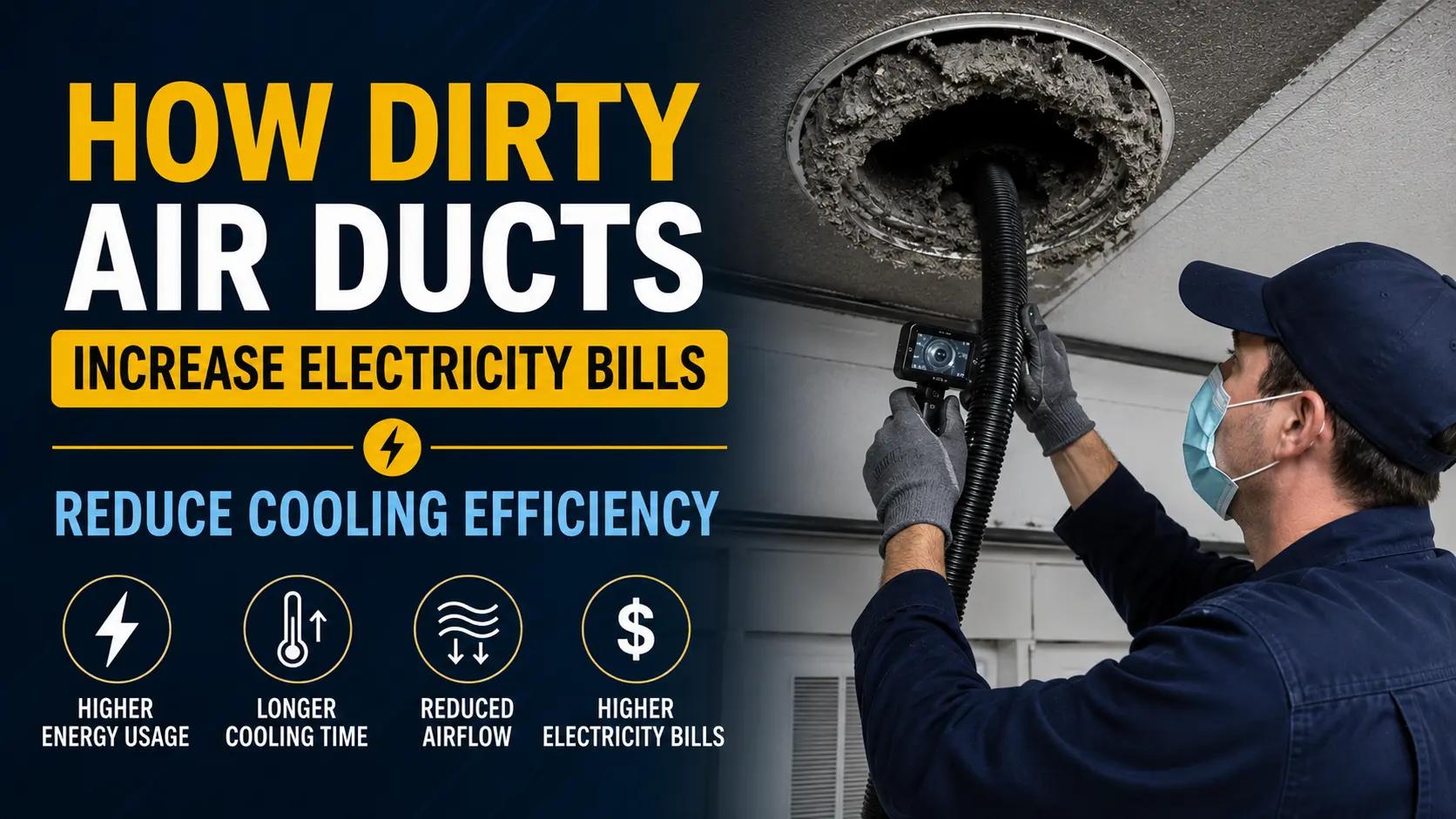
Have you noticed your AC taking longer to cool your home or office? Are your electricity bills increasing even though your usage hasn’t changed much? The problem may not be your air conditioner. It could be your air ducts.
Air ducts carry cooled air from your HVAC system to different rooms. Over time, dust, dirt, mold, pollen, and other contaminants build up inside these ducts. This restricts airflow, forces your system to work harder, and leads to higher energy consumption.
In this guide, you’ll learn how dirty air ducts affect cooling efficiency, increase electricity bills, and why regular air duct cleaning is one of the smartest maintenance investments for homes, offices, hospitals, hotels, and commercial buildings.
Table of Contents
What Happens When Air Ducts Become Dirty?
Your HVAC system depends on smooth airflow. When dust and debris accumulate inside air ducts, the pathway for conditioned air becomes partially blocked.
This creates several problems:
- Reduced airflow throughout the building
- Uneven cooling between rooms
- Longer AC running time
- Higher electricity usage
- Increased wear on HVAC components
- Poor indoor air quality
Think of it like breathing through a blocked straw. The harder it is for air to move, the more effort your HVAC system has to make.
How Dirty Air Ducts Increase Electricity Bills
Many people assume rising electricity bills are caused by an aging AC unit. In reality, dirty ductwork can also be a major contributor.
1. Restricted Airflow Makes the AC Work Harder
Dust buildup narrows the inside of air ducts. As airflow decreases, your HVAC system must run longer to maintain the desired temperature.
The longer the compressor and blower operate, the more electricity they consume.
Even a small reduction in airflow can noticeably increase monthly energy costs.
2. Cooling Takes Longer
If cool air cannot move freely through the ducts, rooms need more time to reach the thermostat setting.
For example:
- A room that normally cools in 10 minutes may now require 18 – 20 minutes.
- This additional runtime increases energy consumption every single day.
Over several months, this translates into significantly higher electricity bills.
3. HVAC Components Experience More Stress
Dirty ducts don’t only affect airflow.
They also place extra strain on important HVAC components, such as:
- Blower motors
- Compressors
- Cooling coils
- Air filters
- Fans
When these components operate under constant stress, they consume more power and may require costly repairs sooner than expected.
How Dirty Air Ducts Reduce Cooling Efficiency
Cooling efficiency means how effectively your HVAC system delivers conditioned air throughout the building.
Dirty ducts reduce this efficiency in several ways.
Uneven Room Temperatures
Some rooms may remain warm while others become cold.
This usually happens because airflow is restricted before reaching distant supply vents.
People often lower the thermostat even further, causing the HVAC system to run continuously.
Poor Air Circulation
Dust accumulation disrupts balanced airflow.
Instead of receiving the designed amount of cool air, occupied spaces receive much less.
This creates uncomfortable indoor conditions, especially during summer.
Reduced System Performance
Your air conditioner may be functioning perfectly.
However, if the duct network is dirty, the cooling produced by the system never reaches the rooms efficiently.
This means you’re paying for cooling that isn’t being fully delivered.
Real-World Example
Imagine two identical office buildings.
Office A
- Clean air ducts
- Regular HVAC maintenance
- Balanced airflow
- Comfortable indoor temperature
- Lower electricity costs
Office B
- Dust-filled ducts
- Blocked airflow
- AC runs longer every day
- Employees complain about poor cooling
- Higher monthly electricity bills
Both offices use the same HVAC equipment.
The difference is simply the condition of their air duct system.
Hidden Problems Caused by Dirty Air Ducts
Higher electricity bills are only one part of the problem.
Dirty ducts may also lead to:
- Dust is circulating throughout the building
- Increased allergens
- Mold growth in humid environments
- Unpleasant odors
- Reduced indoor air quality
- Faster filter clogging
- Shorter HVAC equipment lifespan
For commercial buildings, poor indoor air quality can also affect employee comfort and productivity.
Signs Your Air Ducts Need Cleaning
Watch for these common warning signs:
- Electricity bills are increasing without explanation
- Weak airflow from air vents
- Rooms cooling unevenly
- Visible dust around vents
- Musty smell when the AC starts
- AC running longer than usual
- Excessive dust indoors
- Frequent HVAC maintenance issues
If you notice several of these signs together, it’s time to inspect your ductwork.
Why Robotic Air Duct Cleaning Is More Effective
Traditional cleaning methods often cannot reach deep inside long duct systems.
Modern robotic duct cleaning uses camera-guided equipment with rotating brushes and high-powered vacuum systems to clean the entire duct network more thoroughly.
Benefits include:
- Better removal of dust and debris
- Improved airflow
- Faster cooling performance
- Lower energy consumption
- Cleaner indoor air
- Reduced strain on HVAC equipment
For large commercial HVAC systems, robotic cleaning offers greater precision and consistent results.
How Often Should Air Ducts Be Cleaned?
The ideal cleaning schedule depends on the environment.
General recommendations include:
| Building Type | Recommended Cleaning |
| Residential Homes | Every 3–5 years |
| Offices | Every 2–3 years |
| Hospitals | More frequent inspections and cleaning |
| Hotels | Every 2–3 years |
| Restaurants | Based on usage and grease accumulation |
| Industrial Facilities | Regular inspections as part of preventive maintenance |
Buildings with heavy dust, ongoing construction, or high occupancy may require more frequent cleaning.
Best Practices to Maintain Efficient Air Ducts
To improve cooling performance and reduce electricity costs:
- Replace HVAC air filters regularly.
- Schedule periodic duct inspections.
- Clean supply and return vents.
- Seal duct leaks to prevent air loss.
- Keep cooling coils clean.
- Service your HVAC system annually.
- Use professional robotic duct cleaning when needed.
Preventive maintenance is far less expensive than emergency HVAC repairs or consistently high electricity bills.
Conclusion
Dirty air ducts quietly reduce your HVAC system’s performance while increasing your electricity bills month after month. Restricted airflow forces your air conditioner to run longer, wastes energy, and creates uneven cooling throughout your building.
Regular air duct cleaning, especially with advanced robotic technology, restores proper airflow, improves cooling efficiency, enhances indoor air quality, and helps extend the life of your HVAC system.
At Pioneer Marine, we provide professional robotic air duct cleaning services for commercial buildings, industrial facilities, offices, hotels, hospitals, and marine environments. Our advanced cleaning solutions help businesses improve HVAC performance, reduce energy costs, and maintain healthier indoor air.